Estimated resetBeijing Pending official confirmation
Official evidence@Tibo replied: @rxmphai I'll do another performative reset on Monday
Codex Community Notes
Reset-card reminder
Check when your reset cards expire
Some promotional reset cards may expire soon. Open Settings → Usage left → Available resets, then expand Usage limit reset to see the expiry time. Use cards before they expire.
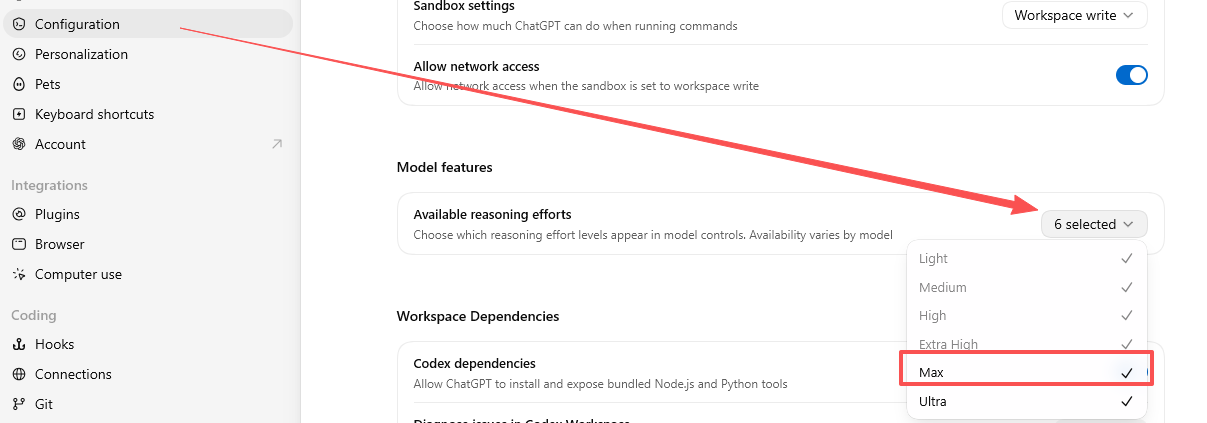
How to enable Max reasoning effort
Open Codex Settings → Configuration → Model features → Available reasoning efforts, then select Max. It will appear in model controls for supported models.
Official DeepSeek guide
Official DeepSeek Codex integration guide
Follow DeepSeek's official setup instructions to use DeepSeek models in Codex.
Of 32 verifiable resets in Codex Radar history, 19 occurred from 00:00 to 08:59 Beijing time. The site treats 16:00–22:00 as a relatively safer card-distribution window; this is a historical pattern, not a guarantee.
◎Station Picks
Practical picks derived from the latest distributed test results.
Current recommendations focus on models available through a Codex subscription; DeepSeek uses separate API billing and will be evaluated and recommended separately.
LIVE
⚠Degradation Alerts
Only sustained IQ declines versus the 24/48-hour averages.
LIVE
🧠 Intelligence Efficiency
Loading update time
Community-tested data · every contribution makes the results more accurate. Contribute now →
Loading efficiency data...
Historical data comparison
Select one or more configurations to compare their history.
No configurations selected.
Community Score
Please rate only models you used in the last 24 hours to avoid adding noise. Thank you.
SPEED-RUN WINDOW OPENAnother performative reset is previewed for Monday
Still have quota to use? Go to Distributed Radar and follow the Tibo source post ↗.
Banked reset cardNot announced
this is a direct reset
This official signal concerns a direct usage reset, not a new banked reset credit.
Hard quota resetOpen
Monday reset preview
At Aug 9, 04:34, Tibo replied that another performative reset will happen on Monday; the direct official reply opens the speed window.
Tibo Radar
--:----Calculating
San Francisco Bay Area / PT
Coarse public time-zone estimate
The supplied public posts do not explicitly disclose a current country or region, so the default timezone is used. Source ↗
OriginalMidnight coding is the best coding. Until you read the code the next day at least.
Chinese translation午夜写代码才是最爽的。至少在你第二天读到那些代码之前是这样。
Model context reading · Belgian Francophone phrasing lensA joke about late-night code feeling great until it is reviewed the next day; it contains no reset, limit, usage, or shipping commitment.
Original@scaling01 And why exactly would this be a good idea
Chinese translation@scaling01 那这到底为什么会是个好主意?
Model context reading · Belgian Francophone phrasing lensThis is an ordinary challenge to an idea about launching GPT-6 on a livestream, with no reset, quota, or limit commitment.
Model context reading · Belgian Francophone phrasing lens“yw” abbreviates “you’re welcome.” The subscription context does not make this a reset or quota promise.
Up to 20 runs per desktop view; swipe or use the arrows for older history.
No publishable Fast Radar history yet.
Method
Method: Sol, Terra, and Luna use low reasoning effort with the same count-from-1-to-1024 output task. Standard and Fast each run three independent samples and use the arithmetic mean; order alternates, up to three model pairs run concurrently, and each pair still runs Standard/Fast serially. Every sample uses a fresh app-server and ephemeral thread plus a random nonce. Complete outputs with cached_input_tokens = 0 are preferred. For this run, slow samples and complete cache-mismatched pairs are retained as real same-day experience; incomplete outputs are rejected and rerun. TTFT is delay to the first visible token, TPS is sustained token generation speed, and E2E is total time from submission to the complete result. Headline acceleration values are calculated as mean Standard divided by mean Fast; per-model E2E acceleration uses that model's Standard divided by Fast.